How to Form 1,200 Barre Chords Yourself – for Guitarists Who Can Read Sheet Music
Discover a revolutionary method to master 1200 barre chords on the guitar. This unique system is specifically designed for guitar players who can read some sheet music and want to take their playing to the next level.
The basics of the barre fingering method
What sounds incredible at first follows a logical system. The 1200 barre chords are based on just 5 basic open chords, known as chord patterns (CP):
- CP 1 = E major
- CP 2 = A major
- CP 3 = C major
- CP 4 = D major
- CP 5 = G major
I have created a total of 157 different barre fingerings using my method, which are distributed among the individual GMs as follows: GM 1 = 44, GM 2 = 33, GM 3 = 22, GM 4 = 26 and GM 5 = 32. However, since not all GMs can be used for every root note because some of them are too high on the fingerboard, the total number of possible chords is not calculated as 157 x 12 (semitones of a scale), but is in any case at least 100 chords for one root note and more than 1200 barre chords in total (100 x 12).
For the root note F, for example, there are 157 – 32 (GM 5) = 125 barre fingerings, for the root note C at least 111, because the GM 3 and 4 are not possible, they are too high on the fingerboard.
The anatomy of a major chord
Root note
The base note of the chord. Can occur in different octaves and determines the name of the chord. It is represented by a black circle O in bold.
Third
Is 4 semitones above the root note. It is represented by an oversized black dot ● in bold.
The minor note is half a tone lower, it is shown as a grey oversized dot ● followed by the grey letter m for minor.
Fifth
Lies 7 semitones above the root note. Strengthens the sound of the chord and ensures completeness. The note is shown as a capital Q in bold.
Every simple major chord consists only of these three notes, regardless of the order. As the guitar has six strings, individual notes occur several times. The decisive factor for the method is that you as a guitarist always know which note you are forming on each string.
The 5 basic chord patterns
Chord pattern 1: E major
In this pattern, the root note and the barre finger are on the high and low E strings. This pattern is the basis for 44 different barre fingerings for one root note. The fingering usually goes over 3 frets.
Chord pattern 2: A major
Here the fifth is on the high and low E-string. This pattern enables a further 33 barre fingerings for one root note. The fingering also usually goes over 3 frets.
Chord pattern 3: C major
In this chord pattern, the third lies on the high and low E string. This pattern enables a further 22 barre fingerings for one root note. The F major chord is often used as the starting point for barre fingerings. The barre fingering usually goes over 4 frets.
Chord pattern 4: D major
In this chord pattern, the third is also on the high E string. However, the barre finger must be moved two frets towards the nut to form the basic shape for barre fingerings. The 9th note now lies on the low E string, in the case of the F major chord here the note G. Because this note does not fit with the Fmajor chord, the low E string must be muted.
This fingering pattern creates a further 26 barre fingerings for one root note. Here, too, the F major chord is often used as the starting point for new chords. The barre fingering usually goes over 4 frets.
Chord pattern 5: G major
The fundamental lies on the high and low E-string, similar to GM 1, but here the barre finger has to be moved three frets towards the nut, which requires a special hand position and is somewhat difficult. This fingering pattern enables a further 32 barre fingerings for one fundamental note. Here too, the barre fingering usually extends over 4 frets.
C Chords in notes
Here we see C chords in notes that the guitarist must read and understand in order to grasp my system of barre chords.
The newly added notes are shown as large black dots in the double-stop. Only the simple minor chord is shown here; for Cm7, for example, only the note E would have to be converted to E flat, etc. for other Cm variants.
The chords are, of course, shown in their simplest and most ideal form. However, the guitar has 6 strings, and the double notes have been omitted for ease of understanding.
The order of the notes on the guitar is also irrelevant, but each required note must occur at least once.
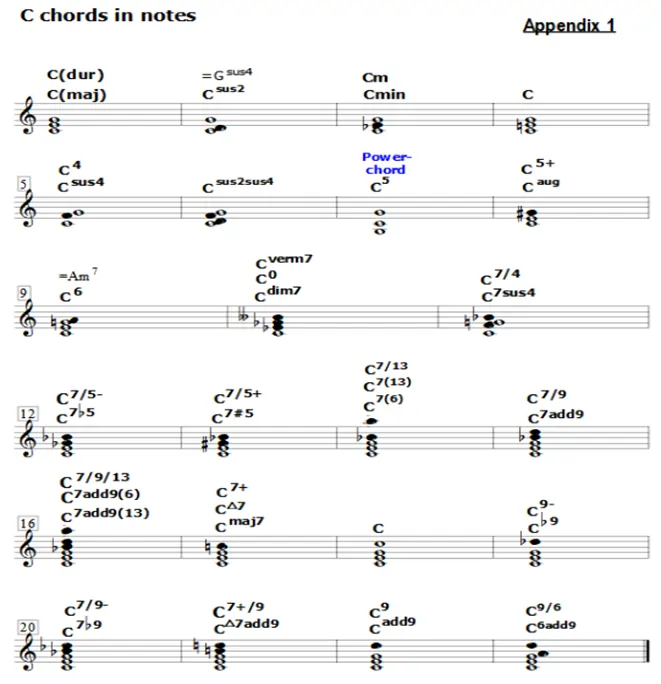
The name of a chord at the top is a European name if it differs from the English one. The new notes are large black dots.
Deriving new chords
Basic major chord
Start with one of the five basic chord patterns and identify the position of the root, third and fifth on each string.
Modify fingers
To create a new note, move a finger in front of the barre finger towards the bridge or lift it. For example, a major third can be changed to a minor third.
Creating a new chord
The modification creates a new chord type such as minor, seventh chord or sus4. The new notes are marked in grey in my method and rise from the 2nd to the 9th note in semitone steps of a scale.
For chord patterns 1, 2 and 5, it is recommended that you first finger the new chord in C major. For chord patterns 3 and 4, we start with F major. After the modification, you can move the barre finger with the other fingers to play the desired chord in any key.
Practical example: From C major to C7 and from E flat to E flat 7 chord
Let's take chord pattern 2 - C major chord as an example. We want to create a C7 chord by adding the minor seventh (B♭). Identify the notes in the C major chord: C (root), E (third), G (fifth).
- In fingering pattern 2 the barré finger for the C chord is placed on the first fret, and the fifth of the C major chord, i.e. the note G, is placed on each of the E strings.
- Find a note that you can turn into B♭ by moving or lifting the finger.
- Modify your finger position accordingly - here, lifting the finger on the G string = the note C now becomes B♭.
- The new C7 chord is formed.
See excerpt from appendix 17 - CP 2 with possible derivations:
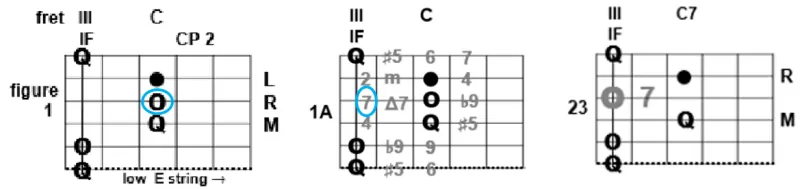
If we were looking for an E flat 7 chord, there are two ways to derive it from the C7 chord:
- We move the fingering pattern with all fingers from C to E flat, which is 3 semitones or 3 frets higher, namely C → C sharp → D → D sharp = E flat.
- Or we remember that with GM 2, the fifth is always on the E strings. The fifth of the E-flat major chord is the note B♭, which is on the VI. fret. So we place the barre finger on the VI. fret and play fingering pattern 2. If we now lift the finger on the G string, the barre finger changes the root note E flat to D flat, completing the new E flat 7 chord.
This technique allows you to systematically derive all 1200 barre chords and more without having to memorise them individually. The method utilises your understanding of the chord structure and the position of the notes on the fretboard.
Guitarists who play in a band or orchestra with brass instruments must be able to play barre chords because, from their perspective, almost all pieces of music are written in B flat keys, and open chords on frets I to III are unusable.
Advantages of this method
1200 barre chords
Instead of memorising 1200 and more individual chords, you understand the system and can derive all the chords yourself.
5 basic patterns
Only five basic forms form the basis for the entire system, which makes learning much easier.
12 keys
By simply moving the barre finger with the other fingers, you can play any chord in all twelve keys.
This method revolutionises the learning of barre chords on the guitar. Instead of just learning by heart, it promotes an understanding of the music and guitar technique. Not only will you master 1200 barre chords, you will also develop a deeper understanding of harmony.
Order now
Paperback (excerpt), 76 pages, ISBN: 978-3-384-46855-0
- amazon
- tredition shop
- can be ordered in bookshops
About the author
Günter Beyer is born in 1941 and a passionate guitarist. His book is the result of decades of experience and didactic clarity - ideal for anyone who wants to understand what they are doing on the guitar.
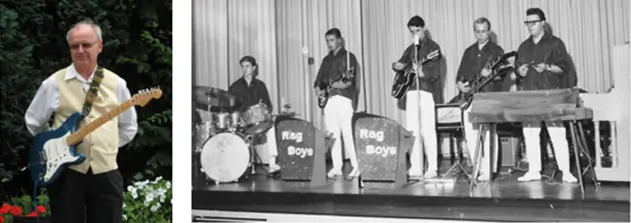
Left: Günter Beyer today
Right: Günter Beyer (3rd from left) with the Rag Boys in 1962
Frequently asked questions
Do I have to be a professional?
No, but a basic knowledge of music is a prerequisite.
Can I also use the book as a beginner?
If you have some experience and can read music, yes.
Is there also an e-book version?
Currently only available as a paperback.
Imprint
Günter Beyer
Provinzialstr. 89
66663 Merzig
GERMANY
Contact: info@barrechords.page